This article was written by David Lee.
In this article, we will discuss seals and their function in the gas lift system. Several important tips will be shared to avoid critical issues that will emerge as the result of a mistake with your gas lift valve packing.
A gas lift valve sits inside the polished bore of the mandrel pocket.
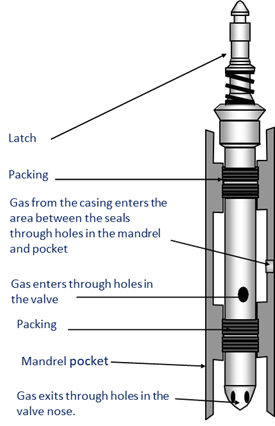
The seal is the only part that actually touches the mandrel.
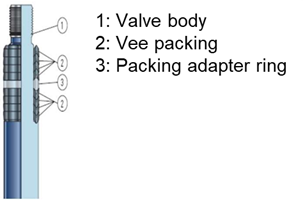
What is the function of the seal in a gas lift valve?
A gas lift valve contains two seals, one upper and one lower seal. Each seal is made of two sets of vee packing (usually 4), each set is installed in the opposite direction of the other with an adapter ring in the middle.
The seal (packing) prevents the gas lift to flow through the side pocket mandrel polished bore, around the gas lift valve. Hence it forces the flow of gas to pass by the inside of the gas lift valve.
It must function for the life of the installation to prevent gas leakage, and erosion of the mandrel seal bore.
The seals must be able to be installed and removed from the seal bore, while holding up to 10,000 psi differential pressure in a variety of environments.
The seal is the only part of the gas lift valve that has significant contact with the mandrel.
- If a valve is difficult to remove, its usually the seal’s fault.
- If a valve is difficult to install it may be the seal’s fault or
- It may be the slickline tool string / mandrel orientation
- It may be the skill level of the slickline operator
Featured courses

Gas lift valve seal material selection and maintenance tips
Seal material is important!
- Don’t use neoprene due to its limited compatibility with crude oil.
- Nitrile comes in a variety of blends.
- Each material has a different maximum operating temperature. In order use
Nitrile (250°F) -> Viton (350°F) -> Aflas (400°F) -> Chemraz (450°F) -> Kalrez (600°F) - Each material has a different resistance to certain chemicals. Hence, it is important to consider the environment (e.g. presence of H2S or CO2) in which the gas lift valve will be used when selecting the material of your vee packing.
Refer to this detailed rubber chemical resistance table for more details and discuss this topic with your gas lift valve supplier:
https://mykin.com/rubber-chemical-resistance-chart
To combine the best properties of different material, you can make a stack of vee packing made of different materials. By doing so you can obtain a stack that can sustain harsher conditions. - The packing stack should not be tight on the valve when you install it. You should be able to rotate it on the valve without effort. If that is not the case, then something is wrong and you should replace it. Packing swells, so if it is tight in the shop, it will probably get damaged as it swells downhole or goes through mechanical efforts while running the valve.
-
Lubricate seals with high viscosity silicon grease (Dow Molykote 111 compound) to facilitate the entry in the side pocket mandrel.

Why are seals or packing important in a gas lift valve?
If the gas lift valve seal doesn’t function properly:
- Gas leaks between the valve and the mandrel polished bore
- Seal bores are flow eroded
- Gas lift valve can get stuck
Hence when selecting your gas lift valve packing material you need to consider:
- HSE exposure to staff and the environment
- Well servicing costs
- Risk to the assets
- Production deferment
What happens if you are not precise with gas lift valve packing specifications?
If the gas lift valve user does not specify the seal material required, contracting and procurement will purchase the cheapest thing that will fit on the gas lift valve and can be called a seal. Indeed, Contracting and Procurement’s job is to purchase and deliver what is specified within the required delivery date at the lowest cost possible. Hence, we need to be VERY specific when requesting the purchase of gas lift valves and the purchase of spares for gas lift valve shops. If we are not specific, we lose the right to complain.