The challenge of renewing oil reserves
Oil and Gas Exploration & Production (E&P) companies face the continuous challenge to maintain their production and replenish their reserves to meet the oil demand.
Between 2015 to 2021, exploration and production companies had to adapt in order to deliver new projects in a low oil price environment. Even if the oil price is picking up, the growing scarcity of resources leads to a higher capital cost per barrel of reserve developed.
Artificial Lift a cost-effective solution to develop oil reserves
The use of artificial lift is a cost-effective solution to develop reserves. While the amount of reserves developed is not as high as drilling wells in proved accumulations, the risks of failure are much easier to manage and the associated reward contains much fewer uncertainties.
For instance, installing an Electric Submersible Pump (ESP) in a well, to increase the drawdown applied on the reservoir and produce a higher rate, contains much fewer risks of failure than drilling a new one. The risk-reward is very interesting and E&P companies should focus on such projects that require lower capital expenses, especially during crisis times like we are currently going through.
A well will almost always need Artificial Lift
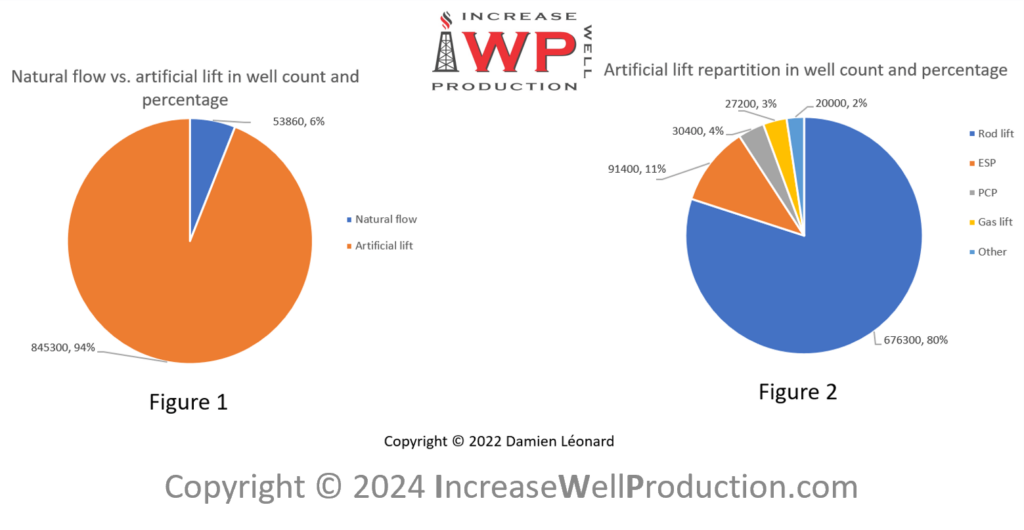
Moreover, with reservoir pressure depletion and water-cut increase, the need for artificial lift is almost inevitable. This statement is proved by the fact that, according to World Oil Magazine, 94% of all oil-producing wells in the world use some form of artificial lift. So that is more than 900 000 oil-producing wells that use artificial lift (figure 1).
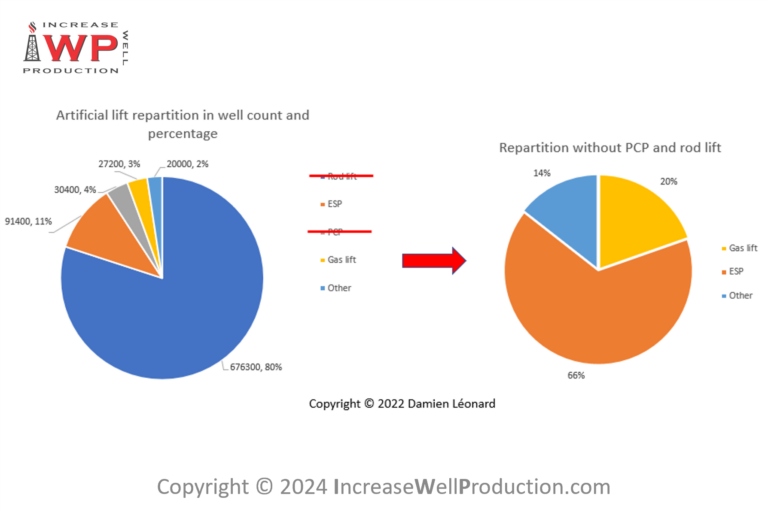
As per figures from Lufkin Industry established in 2012 (figure 2), most wells use rod pumping (80%). ESP comes in 2nd position with 11%, followed by Progressive Cavity Pump (PCP) with 4% then Gas Lift (3%), and other methods (2%).