Nodal Analysis – Well Outflow
Current Status
Price
Get Started
| Format | On-demand 24/7 |
| Access | 1 year unlimited for 1 person |
| Duration | Approx. 2.5 hrs |
| Certificate | Included w/ 2.5 PDH credits |
| Level | Basic to intermediate |
| Language | English |
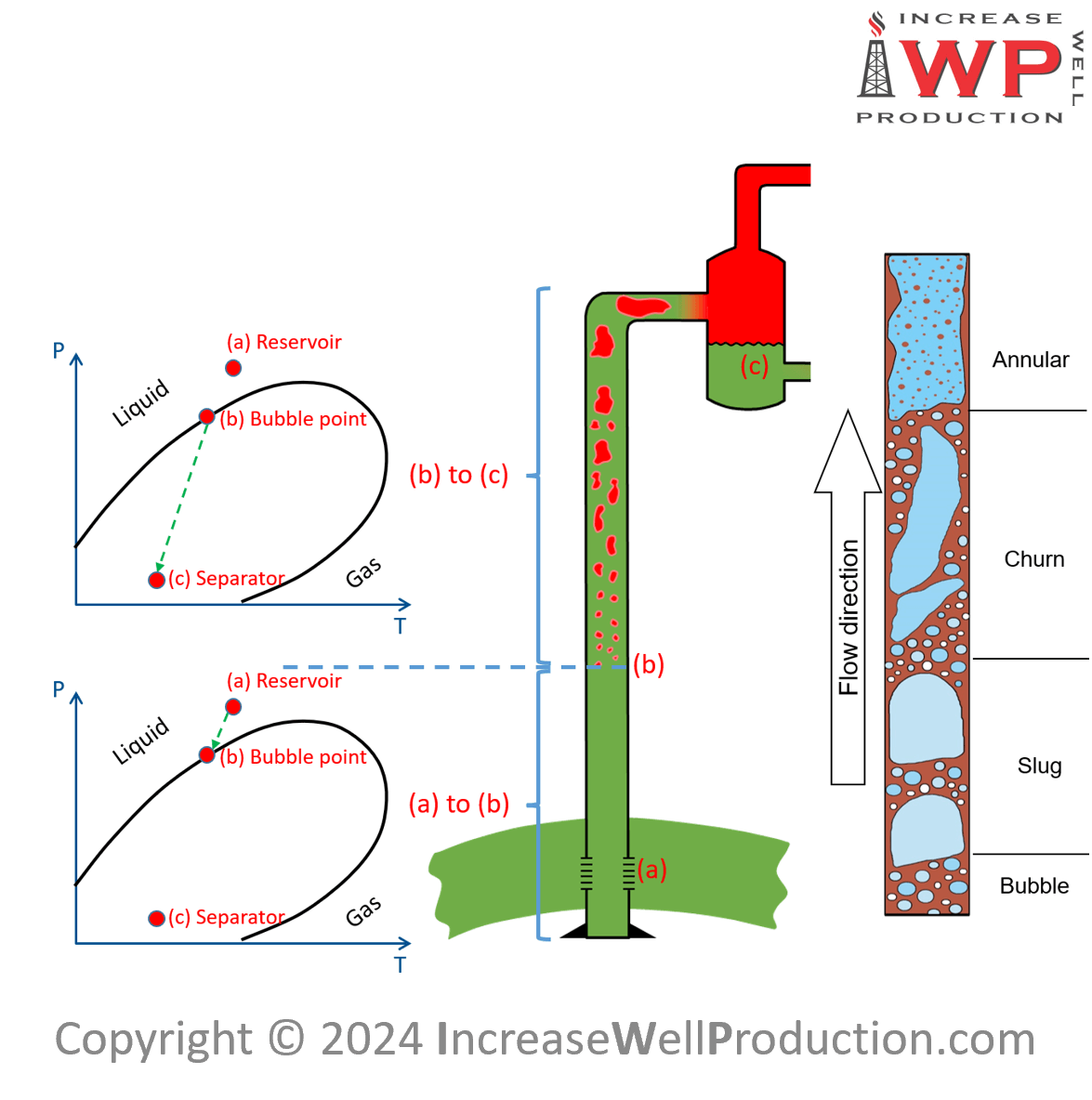
Well performance is the discipline that aims to maximize a well production. It involves the understanding of the well production mechanisms known as the well inflow and the well outflow. The well inflow describes the laws that drive the flow of hydrocarbons from the reservoir to the bottom of the well. The well outflow describes the laws that drive the flow of hydrocarbons from the bottom of the well to the surface.
Both mechanisms are part of what is called the nodal analysis. Nodal analysis studies the evolution of the pressure between two system nodes. Applied to well production, the system usually starts with a node in the reservoir and finishes with a node in the surface tank or production separator. Fluid movement from one node to the other will trigger an evolution of the hydrostatic pressure and of the frictions (or pressure losses). The change of these two pressures (hydrostatic & frictions) will be equal to the difference in pressure between both system nodes. By measuring the pressure at a specific node (for instance, using a pressure gauge installed in the production separator) and using nodal analysis, the pressure in another node of the system can then be calculated and used to decide on specific action aiming at increasing the well production.
This course connects reservoir engineering to well performance and petroleum engineering. Participants will acquire a good understanding of the well outlfow mechanism.
Taken together with Nodal Analysis – Well Inflow, it will teach what a senior petroleum engineer should know about nodal analysis, well performance and well production.
Well production mechanisms are one of the most important things to understand when working at optimizing a well. Whatever if a well is in natural flow or if it uses artificial lift, mastering the concepts of inflow and outflow will allow to understand any well behavior and optimize it.
Our Nodal Analysis – Well Outflow course offers a comprehensive approach to analyzing and solving well production problems. We provide practical examples to help students develop the skills needed to increase the production of their wells.
This course focuses on the outflow mechanism. Students will be guided to many key concepts like vertical lift performance curves (aka VLP curves), pressure losses, flow regimes, nodal analysis… The instructor will share a method to select the most appropriate multiphase flow pressure correlations to achieve a good matching with your nodal analysis software Prosper.
Well performance, reservoir and petroleum engineering will be all linked. You will be shown how PVT and other parameters impact the production of your well.
Gas production will also be discussed through the concepts of critical velocity and liquid loading. The instructor will explain practical solutions that can be implemented to deliquefy a liquid loaded gas well.
By following this course students will learn how to increase the production of any oil and gas well.
- Fluid path from bottom to surface
- Hydrostatic pressure and pressure losses
- Vertical flow pressure curves and sensitivities to GLR & WHP variations
- Vertical lift performance (VLP) curve
- Hold up and slip velocity
- Horizontal & vertical flow regimes
- Flow pattern maps
- Impact of PVT on the outflow in oil wells (viscosity, bubble point and solution GOR)
- Gas well:
- Impact of PVT on the outflow (dew point and CGR)
- Liquid loading and how to avoid it
- Turner’s critical velocity
- Gas well deliquification
- Multiphase flow pressure correlation
- Main correlations available and main features
- How to select the best correlation using a nodal analysis software (Prosper)
- Effect of emulsion on viscosity
- Why you need artificial lift
- How to increase production
- Exercises: Impact of 6 different parameters variation on inflow and outflow
- Production, Petroleum or Well Performance Engineers to maximize their well production
- Reservoir engineers to link reservoir engineering with well production
- Field Production Personnel to understand the criticality of data
- Completion or Surface Facilities Engineers to understand what they can do to help maximizing well production
Course rating
Rate the course
Very useful course
This course is very useful to understand better the well outflow and parameters that impact in VLP. It is a very good refresh Congratulations.
Strongly recommended
I followed the well outflow course when beginning a career transition from geology to reservoir engineering. I found the explanations very clear and straight to the point with exercises well elaborated to reinforce the concepts and cover all the doubts. It is definitely a very good starting point for those willing to go deeper into production engineering. Strongly recommended.
Interesting course
Interesting course to better understand reservoirs in oil and gas. I took this course and it was awesome in giving me a better understanding of wells in oil and gas production.
Cost effective training alternative
I have taken this course as I was looking for a cost effective training alternative for field production engineers in Western Africa, during the 2015 downturn when all budgets had to be drastically reduced. This course proved to be very interesting solution. Very good content, very clear explanations. The feedback received by the field engineers team was excellent. The knowledge of wells mechanisms improved and it was noticed in the operations. I feel I have fully achieved my objectives with this training. I recommend this course if you are looking for a solution to train your operational staff with some years of field experience at a very competitive cost.
Great course
Great course that I actually followed via the bundle which allows for a consistent progression through well productivity. It is pretty easy to follow as the instructor points the reasoning path on pictures. Thanks to the clear explanations and slides, you will get the most of it if you write down notes as school lessons and make the effort to solve yourselves the examples. Provided that, you will reach a good entry working knowledge about the subject. In that particular chapter, the phenomena of flow inside the well itself are covered. In a short time, you will get a good understanding of how hydrocarbons are lifted in a well. That will prepare you to make the most of the artificial lift considerations.
Clear delivery, easy to understand with interactive assignments
I like how the videos are not lengthy, and descriptions are short and concise but clear.
I loved the examples and the discussion covers most of the expected scenarios that we see in day to day surveillance activities.
Overall good, I liked exercise part
For me, slip velocity, holdup and flow regimes were more important.
Regarding the exercises, it would be better to explain Parameter 1 and Parameter 2, and their acceptance ranges during VLP match session, and what we can do to improve their values to acceptable ranges.
Effects of different parameters on VLP and IPR
Great demonstration, especially exercise part to understant different parameters effect on VLP and IPR and correspondingly well productivity
Implementation of theory to real operation
Especially quicklook part of Prosper atract me, as I am planning to analyse wells those are slugging to understand behaviour much better
Really Excellent Course
I really liked the detailed explanations of the VLP, which I think most people are not clear about. Strongly recommend the course for others.
Well Outlfow
I have just completed a training in Nodal Analysis Well Outflow, a highly enriching experience that strengthened my technical skills in well performance analysis, flow behavior understanding, and production optimization. This training helped me better grasp the interaction between the reservoir and the well.
Thanks Leonard
Well outflow review
This course is comprehensive and covers many interesting comcepts. It is particularly valuable for young professionals and also for experinced professionals looking to revisit theoretical fundamentals.
Interesting online training with examples explained with simple word and praticable language
I strongly recommend this course and I encourage such explanations with real experiences and it would be great to demonstrate more real common cases related to onshore and offshore scenarios.
Gas well liquid loading – critical velocity
Water or condensate can fall back in the well, and accumulation at the bottom reduces drawdown. Also liquid loading decreases production and well can even stop.
To increase velocity, you can increase gas rate or decrease tubing ID.
Nice training
Turner’s method is very impressive and interesting.
Practical insights
Great course! I learned how to use nodal analysis to understand well performance and flow behavior. It really helped me see the differences between vertical and horizontal flow, and how gas and condensate reservoirs behave in real situations. Overall the course was clear, practical, concise and highly applicable to real-field scenarios.
Good exercises
Plenty thing learnt especially on gas well. I really appreciate videos which help to understand. Good type of exercises.
I was using prosper without any course before. I now understand how to use and choose correlations.
Again a really interesting course.
well outflow
Good refresh
Great Course! Lots of Information on the finer points of well outflows.
Being from a Mechanical Engineering background in the Oil Field Services industry I was looking for resources to learn more about how gas lift systems work. The Well Production courses have been great along with the Nodal Analysis courses have given me a great peak into how oil/gas and water get to the end of the tubing and out of the ground.
training helpful for PE and our day to day job
Good training.
