ESP Gauges
Current Status
Price
Get Started
| Format | On-demand 24/7 |
| Access | 1 year unlimited for 1 person |
| Duration | Approx. 2 hrs |
| Certificate | Included w/ 2 PDH credits |
| Level | Intermediate to advanced |
| Language | English |
Participants will understand the role of ESP gauges in system monitoring and protection. The course covers key measured parameters, along with sensor principles, system architecture, main components and signal transmission. Attendees will also learn about calibration, troubleshooting, and advanced technologies such as redundant sensors, digital gauges, and ground fault immune designs, enabling them to select and operate ESP gauges for reliable performance. By the end of the course, participants will be equipped to evaluate gauge performance, ensure data reliability, and select the appropriate gauge configuration for enhanced ESP system monitoring and protection.
Electrical Submersible Pump (ESP) Gauges are the eyes of the artificial lift system, providing the critical downhole data needed to monitor performance, ensure equipment protection, and optimize production. This on-demand, online course offers a detailed and practical exploration of ESP gauge design, operation, and troubleshooting—equipping learners to interpret measurements, maintain data accuracy, and select the right gauge configuration for each well environment.
What You’ll Learn:
- Monitoring Fundamentals & Sensor Design: Understand the role of ESP gauges in system surveillance and protection. Learn why downhole measurement is essential and explore the main parameters monitored—intake and discharge pressure, temperature, vibration, and current leakage. Gain insights into sensor construction, working principles, and key technical characteristics that define gauge accuracy and reliability.
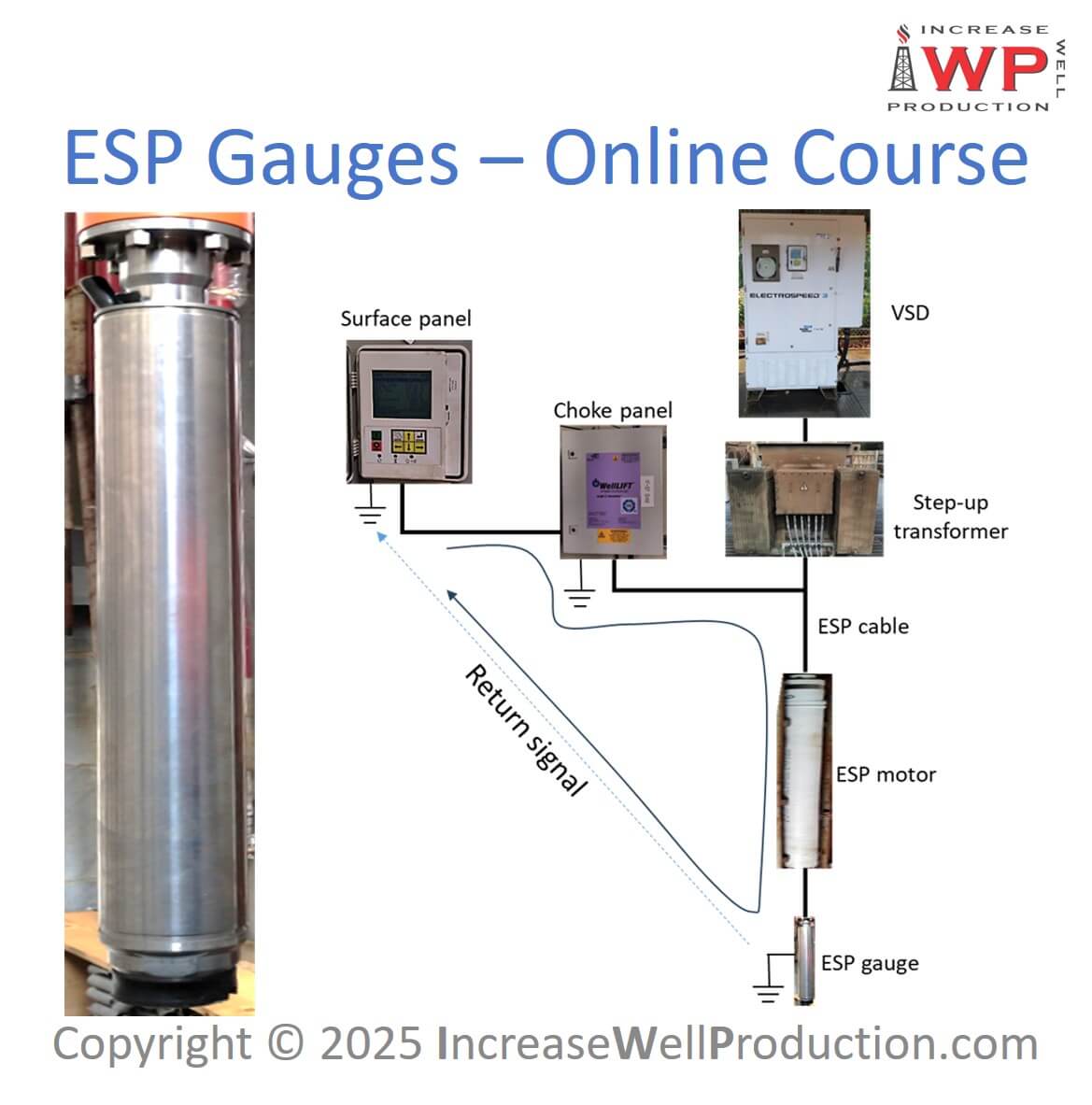
- System Architecture & Components: Examine the full ESP gauge system architecture—from the downhole gauge to the surface choke and electronics panel—and understand how signals are transmitted to the surface. Learn how each component integrates to deliver real-time data for effective system control.
- Troubleshooting, Calibration & Testing: Develop the skills to diagnose and correct common gauge issues, including current leakage, and signal transmission faults. Learn calibration setup, and the use of testing units to validate system functionality and data accuracy.
- Advanced Gauge Technologies: Discover emerging innovations such as double redundant sensors, discharge temperature and flow measurement, ground fault immune designs, and digital gauges. Understand how to select and apply these technologies to improve monitoring precision and system reliability.
Combining theory with practical insights, detailed visuals, and information drawn from multiple ESP gauge suppliers, this course provides an unbiased, comprehensive perspective—not a promotion of any specific manufacturer. It is designed for production and petroleum engineers, ESP specialists, and field technicians seeking to strengthen their understanding of ESP monitoring systems—from conventional analog gauges to advanced digital technologies.
Take the next step in mastering ESP performance optimization—enroll now and learn how to see what your lift system sees.
- The need for an ESP gauge
- Review of main parameters measured
- Intake & discharge pressure
- Motor & intake temperature
- Vibrations
- Current leakage
- Sensors working principles and key technical characteristics
- Other monitored parameters
- Motor Y-point voltage
- Motor fluid conductivity
- System architecture and working principle of signal transmission
- Review of main components
- Downhole gauge
- Surface choke
- Surface electronics panel
- Downhole gauge electronics
- Reverse polarity and current leakage
- Gauge calibration
- System troubleshooting
- Gauge testing unit
- Special gauge offering review
- Double redundant sensor
- Discharge temperature
- Flow meter
- Ground fault immune gauge
- Digital gauges
- Gauge nomenclatures
- Surface facilities, Production, Petroleum, Reservoir or Well Performance Engineers
- Field Production Personnel and ESP field technicians
- Completion or Well Intervention Engineers
Course rating
Rate the course
Excellent course on ESP downhole gauges.
I had the opportunity to go through this course as part of a peer review. By background, I have more than 25 years of experience working as an ESP application engineer, both on the service provider side with SLB and on the operator side with companies such as BP and Perenco. This gives me a broad perspective on ESP systems and downhole monitoring, from design to field application.
This course provides a solid and well-structured introduction to ESP downhole gauges, but it goes well beyond what is typically available on the subject.
Compared to most training materials I have seen, it is significantly more detailed and technically comprehensive, covering not only the fundamentals but also practical aspects such as troubleshooting and system understanding.
One of the key strengths is the multi-supplier approach, which gives a broader and more realistic view than courses focused on a single product line. This is particularly valuable for engineers involved in selecting or designing ESP monitoring systems.
I also found the explanation of the system working principles using a pumping analogy especially effective—it brings a lot of clarity to concepts that are often difficult to grasp.
Overall, this is a high-quality and practical course that will be very useful for anyone working with or designing ESP monitoring solutions.
As a suggestion for further enhancement, adding a section on permanent gauges could make the course even more complete.
